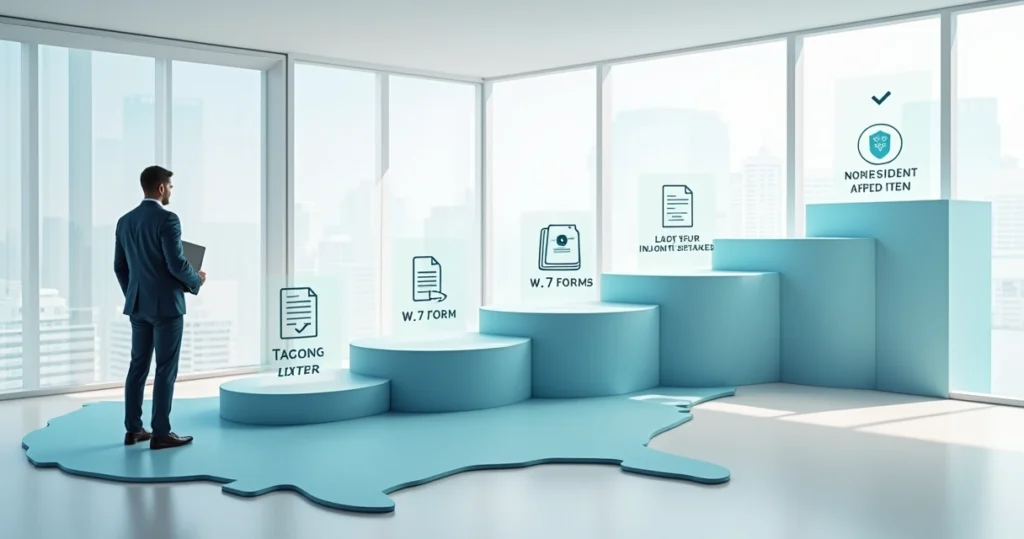
In my years of helping people reach their goals in the United States, I’ve seen how confusing it can be to get started with taxes, credit, or even opening a business if you don’t have a Social Security Number. The IRS created something for these situations: the ITIN. Let’s break apart what it means for you in 2026, why you might need it, and most importantly, how you can get yours smoothly and remotely—without having to mail your passport or set foot outside your home.
What is an ITIN, and who needs one?
An ITIN (Individual Taxpayer Identification Number) is a tax processing number only for those who are not eligible for a Social Security Number but still need to interact with the U.S. tax system. This unique number is issued by the Internal Revenue Service (IRS).
I find people often think only non-residents ever use it. That’s not the case. Both U.S. residents and non-residents might need an ITIN if they have tax reporting requirements but don’t qualify for an SSN. For instance, you could be living outside the U.S. and still need to file a return or report income from U.S. sources. Or maybe you want to start building credit, invest, or open a company inside the U.S.—all of these reasons can make an ITIN necessary according to the official IRS ITIN overview.
Without an ITIN or SSN, it’s impossible to file a tax return in your own name.
Think of ITINs as your official identifier for U.S. federal tax purposes. They don’t provide work authorization, but they do allow access to many parts of the financial system, including opening bank accounts and sometimes helping you begin to build a U.S. credit history.
Eligibility criteria: When do you need an ITIN?
If you are not eligible for a Social Security Number and you have a U.S. tax reporting obligation, you need an ITIN. This includes:
- Non-residents required to file a U.S. tax return (for personal or business reasons)
- Residents or non-residents listed as dependents or spouses on someone else’s tax return
- Owners, partners, or investors in U.S. companies who need to report income
- Foreign students or scholarship recipients needing to file a return
There are other less common cases as well, and the IRS ITIN FAQ gives a clear run-down of possible scenarios. In my experience, if you’re opening a business as a non-resident or want to pay taxes by the book, you probably fall into one of these categories.
The ITIN, SSN, and EIN: Key differences explained
ITINs, SSNs, and EINs are distinct numbers for dealing with the IRS, but they all have specific uses:
- SSN (Social Security Number) is for citizens and authorized residents for work and retirement.
- ITIN is for folks not eligible for SSN but who need to pay taxes, open an account, or claim deductions.
- EIN (Employer Identification Number) is usually for businesses or entities for payroll and reporting.
I find many people get caught up on which number they truly need. If you’re not hired to work in the U.S., and you’re managing your own investments or business, the ITIN is usually the right fit. Further guidance is available in the IRS guide and our own articles on North American documentation.
Step-by-step guide: How to apply for or renew your ITIN
Now to the part that matters most—actually getting your number. Here’s what I usually advise people based on up-to-date IRS methods and streamlined services such as safeitin.com.

1. Gather the required supporting documents
Before anything, you need to prove both your identity and your foreign status. The IRS lists acceptable supporting documents like a valid, unexpired passport (the most common), national ID, or visa. Originals or certified copies are required unless you use a certified acceptance agent, which can save you sending the passport itself.
2. Complete Form W-7
Everyone applying for an ITIN must fill out IRS Form W-7, which asks for basic information, residency, and your reason for needing the number. There are easy-to-follow instructions in the IRS step-by-step ITIN application guide.
3. Choose how to submit your documents
You have several options, but your choice will affect both your comfort and your processing time:
- By mail: You can send Form W-7 and originals/certified copies directly to the IRS ITIN Operations center in Austin, Texas.
- In person: You can visit a designated IRS Taxpayer Assistance Center.
- Certified acceptance agent (CAA): Agents authorized by the IRS can certify document copies for you. I always suggest this when possible, especially when using remote options, as your passport never leaves your hands. For me, this gives unmatched peace of mind. The IRS provides a list of acceptance agents globally.
4. Submit with your federal income tax return (if required)
Most first-time applicants must send the application along with their tax return, unless you fit a listed exemption. The IRS clarifies these situations in their application instructions and on our page about U.S. taxation.
5. Tracking your application and next steps
If you mail your application, you can expect a letter by post with your number, usually within seven weeks. Delays may occur during tax season or if paperwork is incomplete. If you use a service like those powered by safeitin.com, you’ll often get ongoing updates and digital status checks.
With the right support, the process can be 100% remote.
Common mistakes and how to avoid them
I’ve walked plenty of applicants through some avoidable errors. Here are the most frequent, and how you can sidestep them:
- Sending incomplete forms or missing signatures
- Using expired or uncertified supporting documents
- Submitting by mail without tracking, causing anxiety over lost documents
- Forgetting to include your tax return or not checking for an exemption
Avoiding these mistakes can save you months of delay and a lot of stress. More tips about correct documentation can be found in our documentation guidance articles.
Renewing your ITIN: Best practices for 2026
If your ITIN hasn’t been used on a tax return at least once in the last three years, or has digits in the range set by the IRS for expiration (see the IRS FAQ page), you must renew it.
- Submit a new Form W-7 with updated supporting documents.
- There is no fee for renewal through the IRS, though some third-party remote agents charge a service fee.
- Renew before filing season if possible to avoid refund delays.
After renewal, always keep your IRS notification letter, as it will serve as proof until your number is officially active again. For further info on renewals, see our in-depth posts on renewals and updates.
The benefits of certified acceptance agents and remote solutions
From my own work, I can confidently say: using a certified acceptance agent (CAA) can make your experience far smoother, especially for those who value privacy and speed. Safeitin.com specializes in 100% remote applications so you can avoid mailing a passport and get step-by-step support. This is different from classic in-person or mail-only routes. Your progress is tracked and your security is boosted—something I see most international applicants want.

What to do after you receive your ITIN
Once you receive your ITIN, the number should be used in all U.S. tax documents and for opening accounts tied to your U.S. financial identity. Don’t share it unnecessarily—treat it as sensitive data. If your goal is credit building, explore banks and lenders that accept ITINs for account setup or secured cards. Always keep your ITIN documents in a safe, accessible place.
For more about next steps, including business applications or declaring taxes, I recommend reviewing guides such as our post on opening companies with ITIN.
Conclusion: Your first step toward growth in the United States
Applying for an ITIN doesn’t have to be a maze of paperwork and waiting. With the right advice and by working with authorized professionals, you can complete the process from wherever you are, quickly and safely. In 2026, options like safeitin.com remove complexity and offer a human touch. If you’re looking to start a business, build credit, or simply stay tax-compliant, I believe taking charge of your U.S. tax identity is the first step toward new possibilities.
Ready to simplify the process and get started on your goals? Learn more about how safeitin.com can guide you through every stage—all done remotely, affordably, and clearly.
Frequently asked questions
What is a tax ITIN used for?
A tax ITIN allows individuals without a Social Security Number to file U.S. tax returns, open business accounts, and meet tax reporting rules. It is not valid for work authorization, but is accepted by many banks, tax authorities, and sometimes lenders. Its main purpose is to ensure everyone with a tax obligation can be identified and stay compliant with U.S. law.
How do I apply for a tax ITIN?
You fill out Form W-7, attach original or certified identity and foreign status documents, and usually submit them alongside your tax return. You can apply by mail, in person at a Taxpayer Assistance Center, or with help from an IRS-certified acceptance agent. Full guidelines are detailed in the IRS ITIN application instructions.
Who needs to get a tax ITIN?
Anyone not eligible for an SSN but with a federal tax reporting requirement—including foreign investors, dependents, students, spouses, or business partners—needs an ITIN. Those who only want to build credit or open U.S. company bank accounts can also benefit if they cannot obtain an SSN, as explained by the IRS FAQ.
How long does ITIN approval take?
According to the IRS FAQ, processing usually takes up to seven weeks if your application is complete and there are no errors, though it may be longer during peak filing seasons. Remote services and certified agents can help reduce document issues and keep you updated.
What documents are required for a tax ITIN?
Commonly required documents include an unexpired passport, but other options like national ID cards or visas are accepted if they meet IRS standards. Originals or certified copies from the issuing agency must be provided unless working with a certified acceptance agent, as detailed in the IRS guidelines.