When considering building credit, filing taxes, or setting up a business in the United States without a Social Security Number, the Individual Taxpayer Identification Number (ITIN) is a widely used and trusted path. I’ve worked with hundreds of ITIN applicants over the years, and one of the most common questions I hear is: “How much does it really cost to apply for an ITIN in 2026?” The real answer is a mix of costs, choices, and smart decisions, especially for non-U.S. residents or people applying remotely.
In this article, I will share what I have learned about the actual costs applicants face. I’ll explain every detail—official charges, indirect fees, document requirements, and the risks that could cost you extra. I’ll also walk you through how safeitin.com can help you save time, confusion, and money at every step.
The core cost explained—does the IRS charge a fee for the ITIN?
The IRS does not charge any official fee to obtain an ITIN. If you apply using the proper forms and send everything directly to the IRS, you won’t have to pay just to get the number. The official IRS website explains this point, and I’ve seen it remain unchanged for years.
It’s not the number that costs money. It’s the process around getting it done right.
So why have I seen people pay from under $100 up to several hundred dollars for the same outcome? The answer lies in service fees, documentation, mail costs, agent support, and sometimes mistakes that lead to resubmissions. Let me break down each expense—because knowing what to expect is the best way to avoid surprises.
Mail, in-person, agent: Different ITIN application paths and their costs
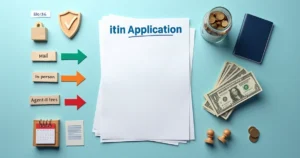
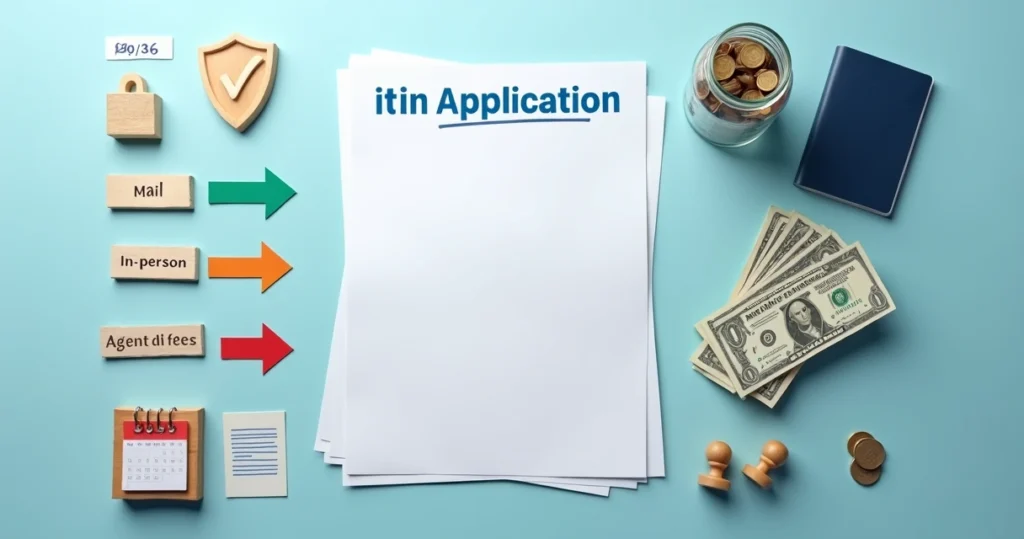
As we get closer to 2026, ITIN applicants have three main ways to send their paperwork to the IRS:
- Mailing the forms and documents yourself
- Visiting a Taxpayer Assistance Center (if available)
- Working with a Certifying Acceptance Agent (CAA) or Authorized IRS agent, like safeitin.com
Here’s how costs and experiences compare:
By mail: Only postage, but high risk for delays and document loss
If you choose to submit Form W-7 and supporting documents by mail, the main cost is postage. There are no direct processing fees.
However, as the IRS guidance on applying from abroad highlights, you must mail either your original passport—or certified copies from the issuing agency—which can introduce new expenses and real risks. Shipping costs vary but usually stay below $20, unless you use a tracking or express delivery service. If applying from outside the United States, international shipping can be much higher.
Mailing original documents also means you’ll be without your passport for several weeks or months, and if it’s lost, replacing it can cost hundreds of dollars and weeks of time.
Taxpayer assistance centers: Free, but only available in some places
Visiting an IRS Taxpayer Assistance Center (TAC) may be another way to avoid service fees, as staff can verify documents at no cost. TACs, however, usually require an appointment and are mostly inside the United States or select U.S. territories.
For non-residents, expats, or anyone without access to a TAC, this route isn’t practical. Even for people in the U.S., finding an open slot can be hard during the busy tax season.
Using an acceptance agent: Service fee for security, speed, and expert help
I have watched many people choose a Certifying Acceptance Agent—either in person or online—when they want to avoid sending their passport or when they want guidance on tricky paperwork. These agents charge a fee because they certify your documents, check your application, and for remote applicants, they keep the process 100% online with no need for mailing costly originals.
Agent service fees range widely, but $200–$500 is common, depending on:
- If the service is fully remote or requires in-person steps
- The number of dependents/family members included
- Extra services, such as business formation or document procurement
- Language support and other added conveniences
Personally, I have found that the peace of mind and expert help gained by using an acceptance agent are often worth the cost, especially when clients have no backup U.S. visa or struggle with U.S. tax documents. At safeitin.com, I make sure all costs are clear before you start, with no surprise charges midway.

Required documents: What you need and what they might cost
The IRS has strict rules for what you must send. You’ll always need:
- Completed Form W-7
- Proof of identity (usually a passport)
- Proof of foreign status
- Supporting federal tax return (unless you qualify for an exception)
Except in rare cases, you should never send original birth certificates, identity cards, or passports by regular mail. Instead, you can use certified copies done by the passport-issuing authority or a U.S. notary—or let a Certifying Acceptance Agent vouch for your documents. As shared by official IRS supporting documents guidance, most people face these options for documents:
- Original documents: Free, but risk loss during mailing. Replacing a lost passport is time-consuming and costly.
- Certified copies: This is usually safer and preferable. The issuing authority or local consulate charges $30–$100 for each certified copy.
- Notary services: Certified U.S. notaries may charge $10–$50, but the IRS sometimes only accepts certain certifications. Not all notaries abroad are valid.
- Acceptance agent certification: Included in their service fee at safeitin.com. No extra cost for in-house certifications.
If you have dependents or a spouse included in your application, each person will need separate certified identity documents. That means costs grow for families. Based on my experience, a family of four could spend between $100 and $400 just on certified copies—unless they use a CAA agent’s service package.
Indirect costs: Other details that affect the total price
There’s more to think about than just paperwork and agent fees. Sometimes, applicants forget about the indirect expenses that add up. Here’s what to watch for:
- Translation fees: If your documents are not in English, you’ll need certified translations, which cost $15–$50 per page.
- Postage and courier charges: To mail documents safely, track delivery, or pay for express service. For international mail, this may be as high as $100.
- Bank notary or embassy notary costs: For people abroad, getting proper notarization can lead to extra trips or “service” charges at foreign banks or embassies.
- Resubmission or correction costs: If the IRS asks for more documents or rejects a file, you may pay double the above fees for a new certified copy or another agent/translation service.
On multiple cases, I’ve seen applicants who try to “save” on the expert fee end up spending much more when they face rejection and unexpected mail or document expenses later. The most up-to-date standards on forms, exceptions, and documentation can be checked at the IRS revised application standards for ITINs.
Can you apply for an ITIN completely free of charge?
In a few scenarios, this is almost possible. Some IRS-backed Volunteer Income Tax Assistance (VITA) sites offer help and certification for ITIN applications at no cost, as referenced in the IRS VITA materials. But these are rare, often only available during tax season, mostly in bigger U.S. cities, and have long wait times.
For the majority who need remote help, don’t live near a VITA site, or require extra guidance for business or family filings, there will be an unavoidable service cost. If your documents are already certified and you do your own mailings, you might bring the total cost down to postage and document fees, but there’s risk and time involved.
Renewals and repeat applications: Do they cost less in 2026?
ITINs expire if not used on a U.S. tax return for three years, or sooner depending on IRS rules. Renewal requires a new Form W-7 but usually doesn’t ask for proof of filing a tax return (unless the IRS requests otherwise). Costs are lower if you already have certified documents, but if new certifications or agent support are needed, you’ll pay similar fees as for a new application.
I often hear from ITIN holders who let their numbers expire and then wonder if there’s a shortcut. There isn’t, so I always advise keeping current and using reliable channels for renewal. At safeitin.com, I make it clear up front if renewal involves extra charges.

Service transparency: Safeitin.com’s approach for remote and non-resident applicants
For non-U.S. residents, expats, and entrepreneurs abroad, the process demands more than just technical know-how. I started working with safeitin.com because I noticed too many applicants felt lost navigating U.S. tax language and document requirements. Here’s what I stand for at every step:
- Remote, document-secure process: No risk mailing passports across borders.
- Clear price breakdowns: Before you start, you see your total fee for agent certification and support. No surprises.
- Support for families and business setups: Fees cover multiple dependents and/or business documents when needed.
- Step-by-step updates: Applicants get help at each step and avoid mistakes that lead to costly rejections.
I’m proud to help people move forward in the United States, whether their goal is to grow credit, open a business, or simply meet tax requirements. If you want more detail on eligibility, timelines, or specific forms, the resource hubs on documentation, U.S. taxation topics, and North American filings are always available.
Timeline and risks: Waiting, mistakes, and extra costs
Standard IRS processing takes six to twelve weeks per their own timelines. If the IRS requests more information or documents, it can add several weeks and lead to extra mail/postage or notary charges. This is why, in my experience, upfront accuracy and certified documents make all the difference. I’ve worked with applicants who lost several months due to a rejected first submission that could have been prevented by expert review.
A single error on your Form W-7 or document can cost you months and extra fees.
If you need your ITIN for a quickly approaching business opportunity, mortgage, or U.S. bank account, waiting on a resubmission could be the difference between hitting your goals and missing deadlines. That risk is also a hidden “cost” to consider.
Special situations: Dependents, families, and business ties
Every additional applicant (spouse, children, business partners) means repeating the document certification for each person. This often doubles or triples the expected costs—for example, notarization and mailing charges really add up for a family. Some agents bundle services for multiple applicants, which is something I always recommend looking for if you’re including several people on your application. At safeitin.com, multi-applicant packages are designed to be clear and affordable, so no one is caught off guard.
- Families need more certified copies
- Business setups may require extra company documents
- Each dependent must meet documentation rules for age and relationship
For more on family filings, I recommend reading real-world applicant stories, such as those shared at ITIN application journeys or tips for applying as a non-resident at business owners abroad.
Conclusion: Calculating your total ITIN application cost in 2026
After all I have seen, I can say there is no fixed “ITIN application fee”—only the process, choices, and support you pay for. The IRS itself charges nothing, but certified documents and professional help have real value. As costs for passport certification, translation, and expert support change all the time, staying up to date through trusted resources is vital for a smooth experience.
If you want a truly remote, safe, and personalized ITIN application, safeitin.com is designed for you—whether you’re growing credit in the U.S., opening your next business, or simply filing taxes without stress. Ready to start? Talk to an agent at safeitin.com and take the first step with confidence.
Frequently Asked Questions
What is the ITIN application fee for 2026?
There is no IRS fee to apply for an ITIN in 2026. Applicants pay only for certified documents, postage, or services from acceptance agents like safeitin.com. These costs usually range from $50 (self-mail plus one certified document) to $500 (full service with remote certification for multiple applicants).
How do I pay the ITIN fee?
No payment is sent to the IRS for the ITIN number itself. You pay directly to the provider of any extra services you need (agent fees, certified documents, or translation). Payments are usually by credit card, bank transfer, or cash, depending on the provider you use.
Are there extra costs for ITIN application?
Yes, extra costs may include certified document fees, translated copies, postage, and agent service fees. Families and business applicants usually have higher document and service charges than single filers, especially if applying from abroad where mail and certification cost more.
Is the ITIN application fee refundable?
IRS does not charge for ITIN applications, so there is nothing to refund for the number itself. However, fees paid to acceptance agents or for certified documents are generally non-refundable, even if the application is rejected, as these services are provided upon submission.
Where can I apply for an ITIN in 2026?
You can apply by mail to the IRS, at a Taxpayer Assistance Center (in select areas), through an acceptance agent, or, if eligible, with some VITA sites offering free services. For a fully remote, guided, and passport-safe path, safeitin.com is ready to help applicants anywhere in the world.